Where we can helpPlan the installation around the business.
A new office, an equipment move or unreliable connections can call for more than another patch cord. We review the layout, network equipment and available pathways so the cabling scope supports how the site operates.
- Commercial office build-outs and relocations.
- High-rise tenant improvements and occupied offices.
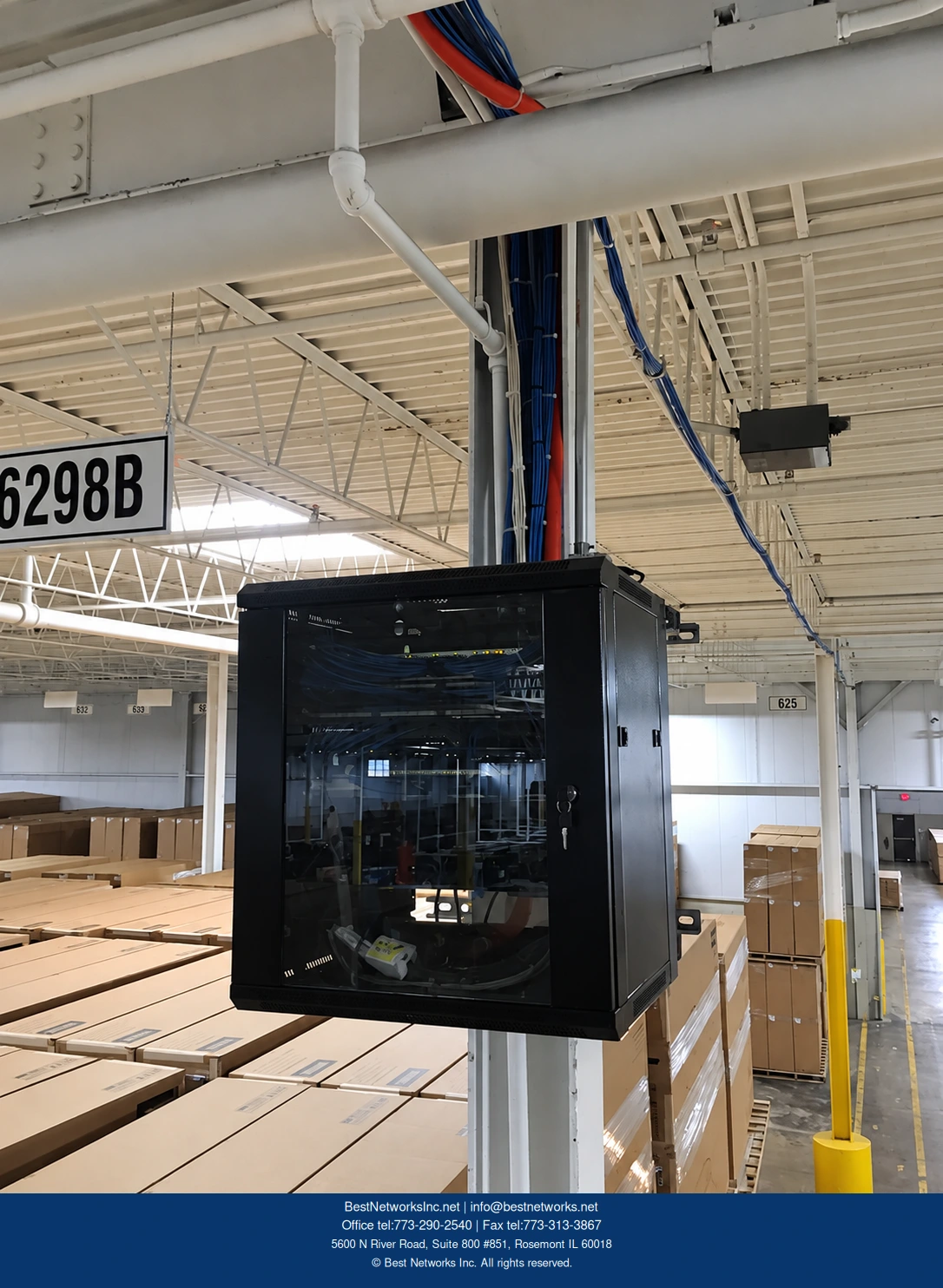
- Warehouses and distribution centers.
- Server closets and MDF/IDF rack reorganization.
- Clinic and healthcare office network requirements, subject to facility access and infection-control requirements.
Our Rosemont office supports Chicago, the O’Hare corridor and surrounding suburbs. Share your site address, access conditions and schedule so we can confirm availability and the installation approach.
Cable selection, standards and building requirements.
Cat6 and Cat6A selection depends on link length, equipment speed, pathway capacity and future changes. PoE/PoE++ also makes conductor choice, bundle conditions and power requirements part of the discussion.
Project specifications may reference the ANSI/TIA-568 family—historically described as TIA/EIA-568—and applicable BICSI installation practices. Share the required standard and edition, including ANSI/TIA-568.2-E where specified, so acceptance criteria can be defined. These references do not imply a BICSI credential.
CMP versus CMR: cable jacket ratings address different installation environments. The actual air-handling space, riser, permitted wiring method and applicable Chicago or suburban requirements determine the selection. A suspended ceiling alone does not establish the correct cable rating.
Chicago and Cook County municipalities can have different jurisdictional requirements. Pathways, supports, penetrations, firestopping and permits must be reviewed for the actual site and authority having jurisdiction.
Project scope checklistKnow what the estimate covers.
Use this checklist to prepare your request. These are items to agree in writing, rather than a promise that every item is included in every installation.
Review the work, deliverables and information needed for each phase.| Project phase | Scope and deliverables to confirm | Information to provide |
|---|
| Site survey & pathways | Route review, supports, conduit or J-hook requirements, access and penetrations. | Floor plans, ceiling conditions, riser access, site rules and working hours. |
|---|
| Drop installation | Cat6/Cat6A category, CMP/CMR rating as applicable, drop count, terminations and outlet locations. | Workstation, access-point, camera and phone locations; any access-control network requirements. |
|---|
| MDF/IDF build-out | Rack or cabinet, patch panels, cable managers, labeling and patching scope. | Rack dimensions, switch space, access clearance, power and bonding requirements. |
|---|
| Closeout & warranty terms | Connection records, photos, as-built documentation, agreed tests and written warranty terms. | Required report format, link IDs, test limits, acceptance criteria and handoff contact. |
|---|
Download the project scope checklist (.txt) ↓
Request a Cabling Estimate ↗Define the test before the installation.
A wire-map or continuity check, bandwidth qualification and standards-based certification answer different questions. Agree the test type, limits and reporting before work begins.
- Copper certification: an appropriate platform such as the Fluke Networks Versiv DSX CableAnalyzer can certify links against specified category limits.
- Fiber testing: Tier 1 uses optical loss testing; Tier 2 adds OTDR characterization. Fluke’s CertiFiber Pro and OptiFiber Pro are examples of tools used for these different tasks.
- Handoff: specify link IDs, test configuration, limits, results and any required electronic reports.
Testing platforms are explained here as industry examples. The equipment, testing service and reports for your project must be confirmed in the proposal.
Useful answersBefore we get started.
What is the difference between Cat6 and Cat6A for an office build-out?
Cat6A supports a 10GBASE-T channel up to 100 meters under the applicable cabling requirements. Cat6 may support 10GBASE-T over shorter distances, often up to 55 meters or less depending on alien crosstalk and installation conditions. Select the category around the required speed, distance, pathway space and equipment—not the category name alone.
When is plenum-rated CMP cable required?
CMP is a communications cable rating for plenum applications; CMR is a riser rating. Environmental-air spaces require a wiring method approved for that space, which may call for CMP cable or another permitted arrangement. The building’s HVAC design, adopted code and local authority determine the requirement. Not every suspended ceiling is a return-air plenum.
Can you review warehouse and high-ceiling cable runs?
Yes. We review the device locations, overhead routes, mounting conditions and access needed for the work. Lift access, operator requirements, J-hooks, conduit, facility traffic and safety coordination must be assessed and included in the agreed scope where required.
Will every drop receive a Fluke certification report?
Only when that certification and reporting are explicitly included in the proposal. Specify copper or fiber, the link or channel test, required limits and digital report format. A continuity check or bandwidth qualification is not a substitute for a standards-based certification report.
What should I send for a cabling estimate or site survey?
Send the site address, approximate drop count, device types, plans or marked-up photos, desired completion date and any building requirements. Include standards, testing, labeling and closeout requirements, plus any requested after-hours work. We can then discuss scope, access and next steps.
Technical references
For buyers preparing specifications: